From the Editors
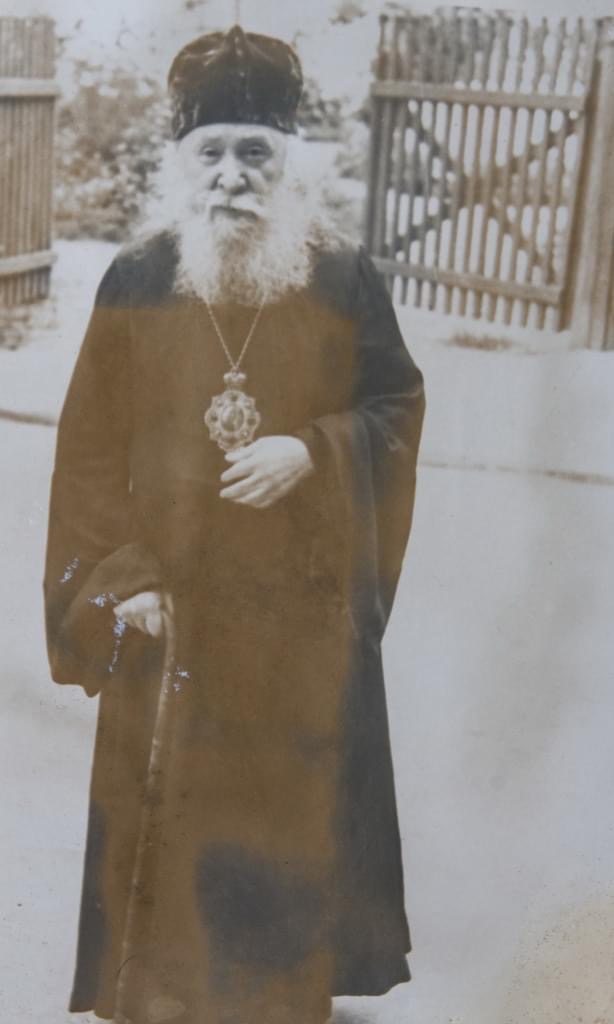
Archbishop Seraphim (Lukianov, 1879–1959) headed the diocese of the Russian Church in Finland in the post-revolutionary period. In 1923, the Finnish government, seeking to establish control over church life, removed him from his position. At the time this letter was written, he was living in retirement at the Konevets Monastery.
Because Finland bordered the Soviet Union, information from there reached Finland more quickly than, for example, Serbia. This explains the author’s level of awareness. Archbishop Seraphim explicitly notes that the letter was not intended for publication: careless disclosure of confidential information from Soviet Russia could have serious consequences for those living there—as had happened with a letter addressed in 1926 by Metropolitan Sergius to the hierarchs of the Russian Orthodox Church Outside Russia.
For this reason, the present text represents a rare document bearing witness to the real situation on the ground shortly before the repose of Patriarch Tikhon. It also confirms the negative attitude toward the decisions of the First All-Diaspora Council of 1921 (in Sremski Karlovci) concerning the restoration of the monarchy in Russia.
Protodeacon Andrei Psarev
February 16, 2026
Jordanville, New York
Dear Vladyka,
Recently I managed to obtain some accurate information about church affairs in Russia, but this information cannot be made public in print.
His Holiness Tikhon is recovering after the third audacious attempt on his life, but he has grown very weak and is terribly overworked. He serves frequently and receives visitors daily. People come to him from all parts of Russia. He has established the following order: he receives no more than fifty people a day; with bishops he speaks no more than ten minutes, and with others no more than five minutes. Sometimes, due to exhaustion, he receives people lying on a sofa. He has aged greatly and appears as a very old man. There is neither a Synod nor a chancellery around him. He avoids issuing written directives in order to prevent complications with the authorities. He has weakened not only physically but also in will—he has become more yielding than he should be and lacks firmness. As a result, bishops often openly oppose his directives, and then he rescinds his decisions.
At present, sixty bishops appointed by His Holiness to various dioceses have gathered in Moscow but are being detained by the authorities. These hierarchs are at liberty but without any work and occupy themselves only by serving in various churches and sustaining themselves in this way, living here and there, somehow and somewhere.
His Holiness Tikhon enjoys enormous authority and love. The commemoration of the Patriarch’s name is forbidden, and in some places people are even persecuted for mentioning his name. He himself does not insist on the commemoration of his name, and now for the most part in Russia they pray as follows: “For the most holy Patriarchs of Constantinople, Alexandria, Antioch, and Moscow.” In general, the Patriarch avoids issuing written directives, since this is dangerous.
There is great dissatisfaction in Russia with the political statements of the Karlovci Council. It is believed that hierarchs must now distance themselves from all political actions, since all of this is laid as blame upon the Patriarch. The attitude toward émigrés in general is negative. There is great anticipation of an Ecumenical Council, with the belief—somehow—that at it there will occur the reunion of the Anglicans and even the Latins. Professor Dmitrievsky is even preparing to travel to the East for this purpose. They hope that foreign powers will compel the Bolsheviks to allow both the Patriarch and the bishops to attend the Council. They do not always have a correct understanding of the situation of the autocephalous churches and of their relationship to our Church.
The question of the new calendar has not died down, and it has a fair number of supporters, especially since the Bolsheviks do not recognize the old feast days and believers are greatly constrained in attending services. It seems that the Bolsheviks again want to put pressure on the Patriarch in favor of introducing the new calendar.
This is what has been reported to me from Russia. I cannot vouch absolutely for the accuracy and reliability of this information.
Here, with us [in Finland], there is a struggle over Pascha. The monasteries and many parishes do not wish to celebrate the new Pascha, while the church authorities do not permit the old one. The situation is extremely acute and difficult. The church authorities threaten persecution against those who celebrate Pascha according to the old reckoning. The white clergy are afraid and do not dare to celebrate according to the old calendar. A terrible hostility is arising between pastors and flock, and between the church authorities and all those subject to them. God is chastising the Phanariots for their blatant lawlessness. This is useful for them. They do not wish to conduct affairs rightly. And it seems that there will be no Ecumenical Council. That may even be for the better. The program of the Council, composed by the Phanariots, is unworkable. To accomplish it, the Council would need to deliberate continuously for two years.
I ask for your holy prayers,
your loving Archbishop Seraphim.